
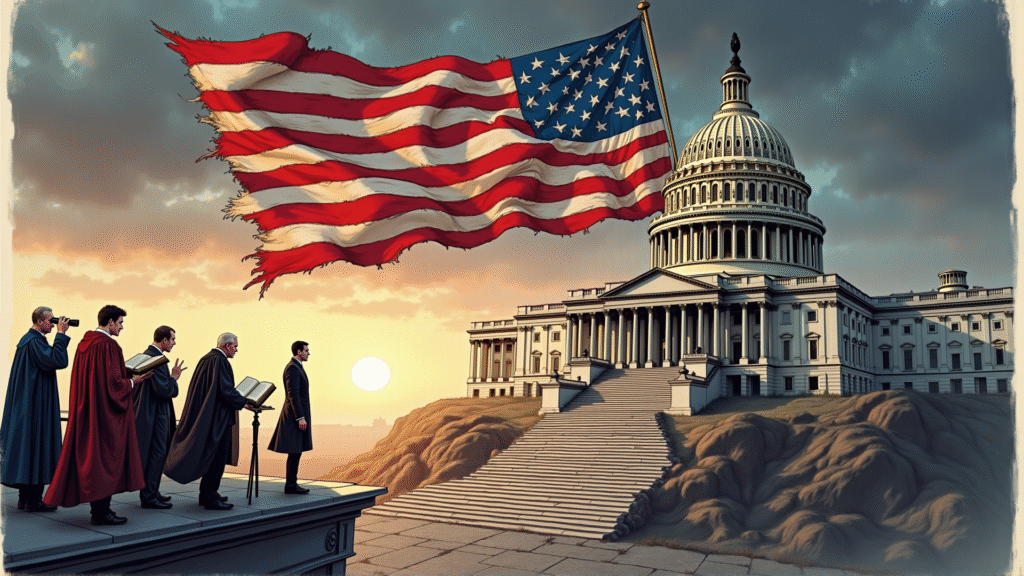
The scholars who study democratic collapse for a living are watching America with the same careful attention that seismologists give to fault lines before an earthquake. Their warnings aren’t partisan talking points or cable news hysteria—they’re conclusions drawn from decades of research into how democracies fail. And what they’re seeing should terrify anyone who believes in constitutional government.
The Pattern Recognition Problem
When Steven Levitsky and Daniel Ziblatt published “How Democracies Die,” they weren’t writing speculative fiction. They were documenting patterns—the same moves, the same rhetoric, the same institutional degradation that preceded democratic collapse in Venezuela, Hungary, Turkey, and Poland. The four horsemen of democratic apocalypse they identified—rejection of democratic rules, denial of opponents’ legitimacy, toleration of violence, and curtailing civil liberties—aren’t abstract concepts. They’re measurable behaviors with predictable consequences.
What makes their analysis particularly chilling is its banality. Modern autocrats don’t need tanks in the streets. They use existing laws, pack courts through normal appointments, and transform civil service into patronage networks—all while claiming to defend democracy itself. The genius of contemporary authoritarianism is that it looks legal right up until the moment it becomes irreversible.
Larry Diamond at Stanford has tracked this phenomenon globally since 2006, documenting what he calls “democratic recession.” For years, American political scientists studied this pattern everywhere except home, treating the United States as somehow immune to the forces that destroyed democracy elsewhere. That comfortable fiction has evaporated.
The American Precedents We Prefer to Forget
The Palmer Raids of 1919-1920 offer a masterclass in how quickly democratic norms can collapse under pressure. Attorney General A. Mitchell Palmer didn’t need new laws to round up thousands of suspected radicals—he simply reinterpreted existing statutes and counted on public fear to provide cover. The raids targeted immigrants, labor organizers, and political dissidents with mass arrests, deportations without trial, and systematic violation of Fourth Amendment protections. The infrastructure of repression was built from existing institutions, not imported from outside.
The Japanese American internment during World War II demonstrated something even more disturbing: how completely the courts can fail as democratic guardrails. When Executive Order 9066 authorized military detention of 120,000 American citizens based solely on ancestry, the Supreme Court blessed it in Korematsu v. United States. The justices who should have been democracy’s last line of defense instead provided legal cover for its suspension.
McCarthyism revealed another vulnerability—how fear-based politics can poison democratic discourse from within. Joseph McCarthy didn’t need storm troopers; he had subpoenas and microphones. The loyalty oaths, blacklists, and congressional witch hunts of the 1950s showed how democratic institutions themselves could become weapons against democracy.
COINTELPRO, the FBI’s illegal surveillance and disruption program from 1956 to 1971, proved that security agencies could operate completely outside democratic oversight for decades. The program infiltrated civil rights organizations, sabotaged political movements, and violated constitutional rights on an industrial scale—all while the public believed they lived in a functioning democracy.
The Contemporary Dismantling
Today’s threats to American democracy follow the historical playbook but with modern sophistication. The Brennan Center has documented over 400 bills restricting voting access introduced across 49 states since 2021. These aren’t random legislative efforts—they’re coordinated attempts to reshape the electorate by making it harder for specific populations to vote. The genius is in the mundane language: “election integrity,” “voter security,” “administrative efficiency.” Who could oppose such reasonable-sounding goals?
The expansion of executive power through emergency declarations represents another slow-motion crisis. Since 1976, presidents have invoked the National Emergencies Act over 70 times, with many “emergencies” lasting decades. These declarations unlock 130 special statutory powers that bypass normal democratic processes. What begins as expedience becomes precedent, and precedent becomes the new normal.
The proposed reclassification of civil servants as political appointees would transform professional government into a patronage system. The Partnership for Public Service warns this would gut institutional knowledge and make government effectiveness dependent on political loyalty rather than expertise. It’s precisely the kind of reform that looks reasonable—who doesn’t want a more responsive government?—while fundamentally altering the nature of democratic administration.
The Institutional Decay Nobody Wants to See
The collapse of local journalism has created information vacuums filled by disinformation and conspiracy theories. When the Reuters Institute documents declining trust in news media, they’re measuring the erosion of democracy’s epistemological foundation—the shared basis of facts necessary for democratic deliberation.
The federal judiciary, once considered democracy’s ultimate guardian, faces unprecedented politicization. When judicial appointments become purely partisan exercises and courts split predictably along ideological lines on fundamental democratic questions, the judiciary transforms from a check on power to an extension of it.
Federalism, that vaunted distribution of power between federal and state governments, increasingly looks less like a safeguard and more like a battlefield. When states and federal government maintain fundamentally different views on voting rights, civil liberties, and basic democratic procedures, federalism becomes a tool for circumventing rather than protecting democratic norms.
The Dangerous Comfort of Historical Analogies
The optimists—historians like Jon Meacham and political scientists like Nolan McCarty—point to American democracy’s previous survivals as evidence of its resilience. They’re not wrong about the past, but they may be wrong about the present. Previous democratic crises occurred in a different information environment, with different global contexts, and—crucially—with elite consensus about basic democratic values that no longer exists.
When Thomas Mann and Norman Ornstein document “asymmetric polarization,” they’re identifying something new: the abandonment of democratic norms as a partisan strategy rather than a temporary deviation. This isn’t politics as usual with the volume turned up. It’s a fundamental reimagining of politics as a zero-sum game where democratic procedures are obstacles to be overcome rather than rules to be followed.
The Reforms That Won’t Come
Democracy scholars propose sensible reforms: campaign finance changes, redistricting reform, voting system modifications, stronger ethics enforcement, expanded civic education. These recommendations assume a political system capable of self-correction, where enough actors value democratic stability over partisan advantage to implement changes that might disadvantage them.
But what happens when the incentive structure itself becomes anti-democratic? When violating norms provides more political benefit than defending them? When a significant portion of the political class no longer believes that democracy—with its messy compromises and frustrating limitations—serves their interests?
The Unlearned Lesson
Larry Diamond writes that democracy “requires the continuous commitment of citizens to the values and practices of democratic life.” This frames the problem as one of civic virtue, as if democracy fails because citizens become lazy or distracted. But that misses the more disturbing possibility: what if citizens are committed, but to incompatible visions of democracy itself?
The real danger isn’t that Americans have forgotten how democracy works. It’s that increasing numbers have concluded it doesn’t work for them. When democratic institutions consistently fail to address economic inequality, social dysfunction, and political corruption, the institutions themselves become the enemy. The tragedy isn’t that democracy is being abandoned carelessly, but that it’s being abandoned deliberately by people who believe they’re saving the country.
American democracy’s greatest test isn’t external threat or internal apathy. It’s the growing conviction among millions of citizens that democratic constraints prevent rather than enable effective governance. When enough people believe that democracy itself is the problem, its defenders find themselves protecting abstractions while its opponents offer concrete solutions—even if those solutions ultimately lead to democracy’s end.
The scholars studying democratic collapse aren’t alarmists or partisans. They’re pattern-recognition specialists watching familiar symptoms manifest in an unfamiliar patient. Their diagnosis is clear: American democracy isn’t dying from assassination but from a thousand cuts, each one justified as necessary, each one setting precedent for the next, each one making reversal harder.
The question isn’t whether American democracy can survive—it’s whether enough Americans still want it to. And every day that question remains unanswered, the answer becomes more ominous.
Sources
How Democracies Die
https://scholar.harvard.edu/levitsky/publications/how-democracies-die
Ill Winds: Saving Democracy from Russian Rage, Chinese Ambition, and American Complacency
https://diamond-democracy.stanford.edu/publications/book/ill-winds-saving-democracy-russian-rage-chinese-ambition-and-american-complacency
On Democratic Backsliding
https://www.journalofdemocracy.org/articles/on-democratic-backsliding/
Voting Laws Roundup: December 2021
https://www.brennancenter.org/our-work/research-reports/voting-laws-roundup-december-2021
The Political Appointee Tracker
https://ourpublicservice.org/performance-measures/political-appointee-tracker/
Digital News Report 2023
https://reutersinstitute.politics.ox.ac.uk/digital-news-report/2023
It’s Even Worse Than It Looks: How the American Constitutional System Collided with the New Politics of Extremism
https://www.brookings.edu/books/its-even-worse-than-it-looks-how-the-american-constitutional-system-collided-with-the-new-politics-of-extremism/
The American Voting Experience: Report and Recommendations
https://web.mit.edu/supportthevoter/www/files/2014/01/Amer-Voting-Exper-final-draft-01-09-14-508.pdf
Bowling Alone: The Collapse and Revival of American Community
http://bowlingalone.com/